
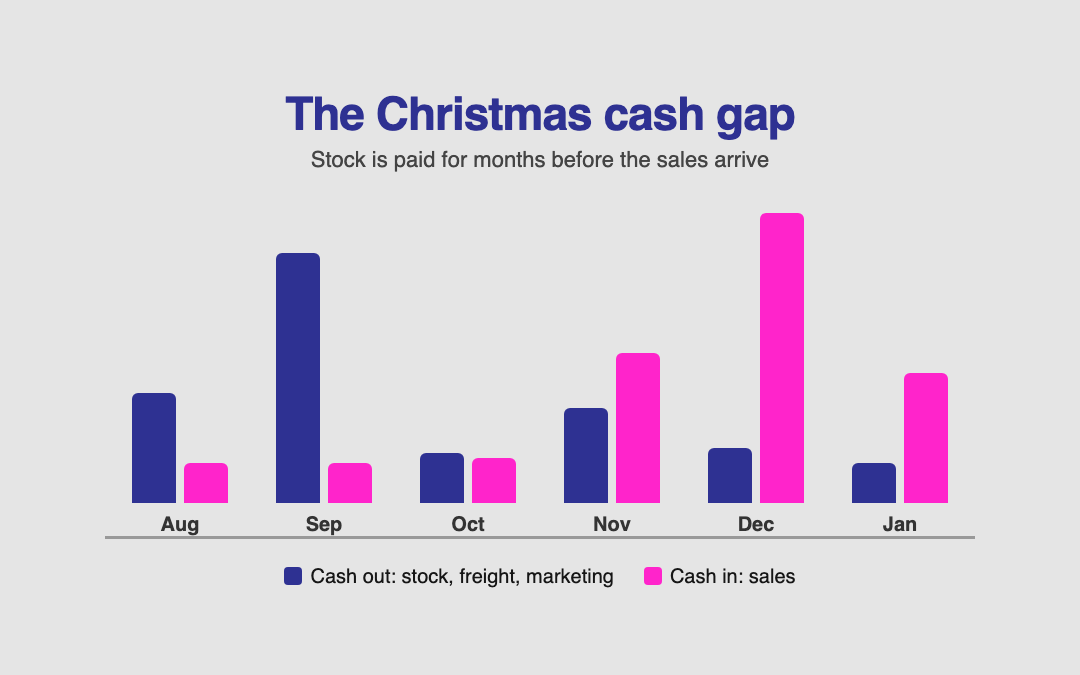
For most Australian retailers and ecommerce brands, November and December bring in a big share of the year's sales. But the stock that drives those sales has to be paid for months earlier, often before it's even left the factory.
That's the Christmas cash gap: money goes out in winter and early spring, and comes back in summer. Funded well, it lets you buy the right stock in the right quantities. Funded badly, it squeezes your cash flow just when you need to spend on marketing, staff and reorders.
Here's how the gap works, which finance suits which part of it, and the mistakes we see businesses make.
The Christmas cash gap, in numbers
This is an illustrative example, based on the kind of situations we regularly see.
Imagine an online homewares brand turning over about $2.4 million a year. In August it orders $300,000 of Christmas stock from an overseas supplier:
- August: a 30% deposit of $90,000 is due when the order is placed.
- Late September: the $210,000 balance is due before the goods ship.
- Mid-October: the stock lands and goes into the warehouse.
- November: the brand spends an extra $40,000 on ads in the lead-up to Black Friday.
- Late November to Christmas: most of the stock sells.
- December and January: the sales cash lands in the bank account.
By mid-November, the business has around $340,000 tied up in stock and marketing that hasn't earned a dollar yet. Its normal monthly costs, from rent to wages, haven't stopped either. Even a profitable business can run short of cash in that window, and that's what finance is for.
Which finance fits which cost
Christmas costs don't all look the same, so the best approach is usually to match each cost to the finance that suits it.
Paying your supplier: trade finance or a trade account
Trade finance pays your supplier directly, locally or overseas, and gives you a set period to repay, ideally timed to when the stock sells. In the example above, trade finance could pay the $210,000 balance in September, with repayment due in January, after the Christmas sales are in.
ScotPac, for example, says its trade finance can cover up to 100% of the order value, used alongside its invoice finance facility. Trade accounts work in a similar way for local suppliers: Shift offers a Trade Account that adds terms of up to $500,000 to supplier invoices, repaid on a date you choose or weekly over up to 20 weeks.
Watch out for: trade finance is arranged order by order and works best before you pay the supplier, so set it up early.
Reorders and marketing: a line of credit
A business line of credit gives you a limit you can draw on and repay as you go. It suits the run of smaller costs that come with a busy season: top-up orders when a product takes off, Black Friday ad spend, freight and casual wages. You only pay interest on what you've drawn, so a facility you barely use costs little.
Watch out for: lines of credit can carry fees even when undrawn, and some have an annual review. Ask about both.
A one-off lump sum: a short-term business loan
An unsecured business loan gives you a lump sum with a fixed repayment schedule. It suits a single large cost, such as a stock order or a new product range, when you'd rather have one simple loan than several facilities.
Watch out for: repayments usually start straight away, often weekly or even daily, while your stock is still on the water. Make sure your cash flow can handle repayments in the months before the sales arrive.
Selling to retailers: invoice finance
If you're a wholesaler or brand selling to retailers on 30- to 60-day terms, your Christmas cash gap is longer still. Invoice finance advances most of the value of your unpaid invoices, so you're not waiting until February to be paid for stock you shipped in October.
Platform advances: fast, but check the total cost
Shopify Capital, Wayflyer and PayPal Working Capital offer funding inside your dashboard, repaid as a share of your sales. That can sound like a good match for seasonal stock, because you repay faster when sales are strong. But most charge a fixed fee, so you pay the same whether you repay in two months or eight, and a share of every sale goes to repayments before the busy season starts. Our guide to Shopify Capital and Wayflyer alternatives shows how the costs compare.
How much should you borrow?
Work out your peak cash need before you talk to a lender:
- List what goes out and when. Supplier deposits and balances, freight and duties, extra marketing, and extra wages, month by month from now to February.
- List what comes in and when. Use last year's peak-season sales as a guide, and allow for the delay before marketplace and payment provider payouts reach your bank account.
- Find the low point. The month where your cash balance would dip lowest is roughly how much funding you need.
- Add a buffer. Sales can be later or slower than planned, and a buffer is cheaper to arrange now than in a hurry in December.
If you can, set repayments to fall after the money comes back in, not before. That's where matching each cost to the right kind of finance pays off.
Mistakes to avoid
- Leaving it too late. Applying the week a supplier payment is due puts you under pressure and limits your options. Lenders need time to assess you, and your broker needs time to compare quotes.
- Funding long-term needs with short-term money. A short-term loan for a store fit-out, or equipment that lasts years, squeezes cash flow. Use finance with a term that matches what you're buying.
- Over-ordering because finance is available. Stock that's still on the shelf in January still has to be paid for. Base orders on realistic sales, not the most you can borrow.
- Comparing repayments instead of total cost. A lower weekly repayment over a longer term can cost more overall. Ask each lender for the total amount you'll repay.
- Forgetting the personal guarantee. Most unsecured business finance needs a director's guarantee. Understand what you're signing.
What lenders look for
Non-bank lenders mostly assess retailers and ecommerce brands on the sales in their bank statements, not on property. Expect to provide:
- 6 to 12 months of business bank statements, or access to your sales platform or accounting software
- last year's peak-season sales, which show you can repay from this year's
- for trade finance, supplier details and purchase orders or pro forma invoices
- details of any existing loans or advances
Depending on the lender, decisions can be as quick as a few hours, but supplier-backed facilities such as trade finance usually take longer to set up the first time.
If you're reading this in November
If your stock is already paid for, you still have options. A line of credit or short-term loan can cover a final balance, a top-up order of best-sellers, or extra marketing in the run-up to Christmas. And once the season's over, look at what worked: the best time to set up trade finance or a line of credit for next Christmas is in the new year, well before you place next season's orders.
How Splendid can help
Splendid is a business finance broker specialising in non-bank and private lenders, and working with banks where they suit. You deal with an experienced broker, backed by our proprietary AI lender matching, which works out your cash flow and serviceability from your bank statements and tests your business against the lenders that offer the finance you need. We get quotes from the best-fit lenders for you to compare, and we're paid by the lender, so there's no cost to you.
See our guide to retail and ecommerce business loans, or download our free ecommerce business finance guide.
If you're planning stock for Christmas or your next peak season, tell us what you need and a broker will call you to talk through your options.